
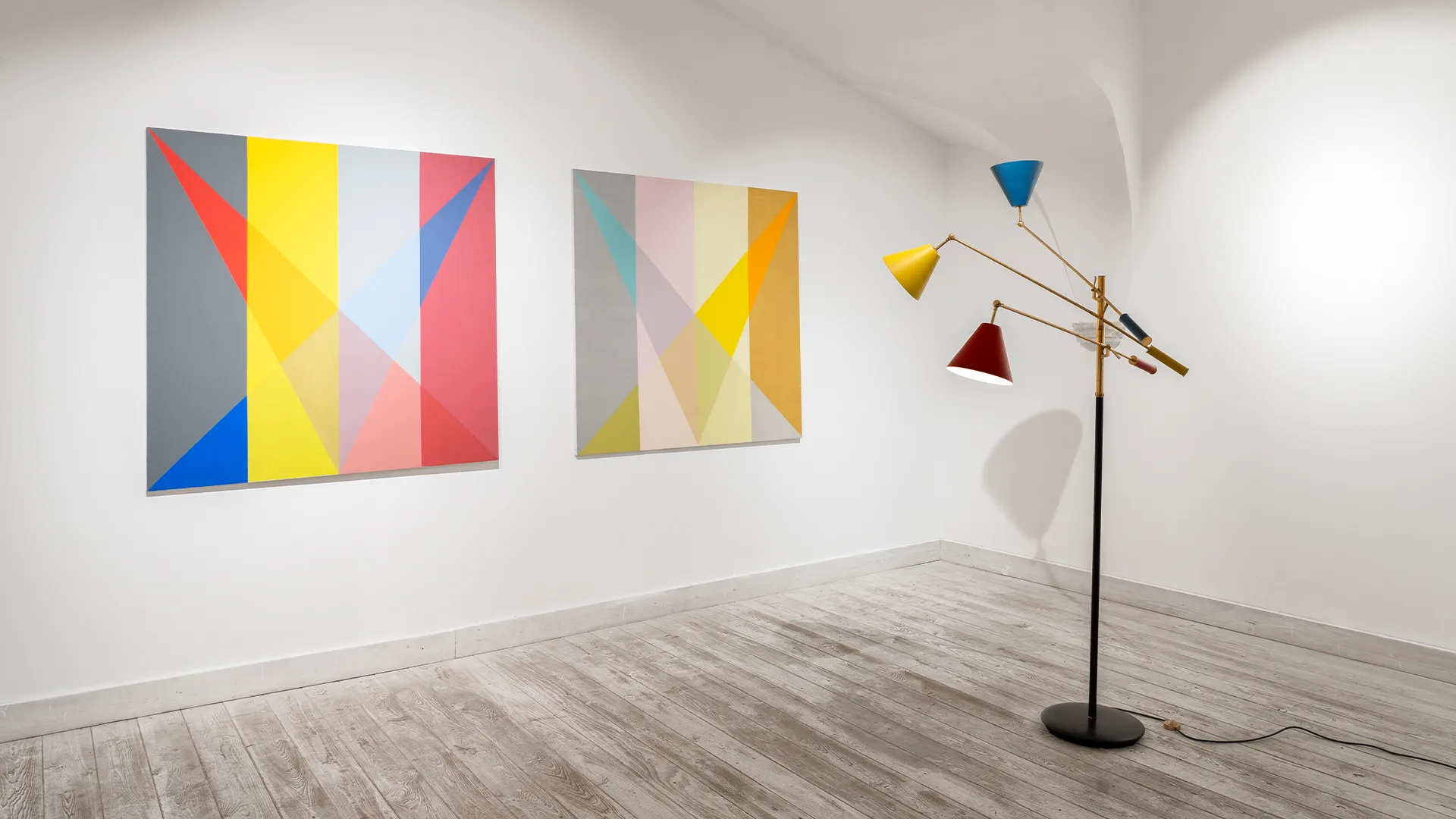
The exhibition I LIKE THIS PLACE. Living with Art and Design, curated by Emanuela Nobile Mino (part of her project “Trésor-en-valise”*), opens the EDDart spaces to a dialogue between modern art and collectible design for the first time.
The exhibition serves as a platform where questions of aesthetics, technique, and functionality converge, fostering an interplay between abstract artworks created by some of the most experimental artists active in Rome from the late 1950s through the 1970s (Achille Perilli, Francesco Del Drago, Giulio Turcato) and furnishings and lamps designed by some of the leading figures in modern Italian design (Angelo Lelii, Ico Parisi, Gio Ponti, Gino Sarfatti, Ettore Sottsass, Vittoriano Viganò, Umberto Riva) and by the sculptor Arnaldo Pomodoro, produced by some of the most enlightened Italian manufacturers (Arredoluce, Arteluce, Cassina, Ditta Vittorio Bega, FontanaArte, Poltronova), and selected by the curator from the collections of the Giustini / Stagetti gallery, which specializes in twentieth-century Italian design and contemporary international design.
The exhibition is therefore presented as a pas de deux between the abstract art movements that emerged in Rome during the late 1950s and 1970s and the innovations of the Modern Movement in designer furniture—which flourished from the late 1930s through the post-war period, particularly in Northern Italy (then the nerve center of industrial and manufacturing production) —an interplay that would subtly echo in furniture design throughout the 1960s.
Abstraction, light, and color are constant elements in the exhibition: they define the language and the informal, evocative nature of the selected artists’ paintings, while guiding the lighting experimentation and functionalist aesthetics of the chosen designers’ work—incorporating a mix of classic and innovative materials, technical solutions, and light sources that were truly cutting-edge at the time of their creation.
Among the exhibited design works is one of the most iconic lamps by Angelo Lelii—founder of the historic Arredoluce manufactory—namely the “Triennale” floor lamp.
First presented at the 1947 Milan Triennale, it features three adjustable arms with differently colored reflectors, serving as a lighting fixture that becomes both a tool and a central element of interior architecture – the lamp appears in the background behind Peggy Guggenheim during an interview featured in Lisa Immordino Vreeland’s documentary *Peggy Guggenheim: Art Addict*, which is dedicated to the life of the renowned patron of the arts; the “Califfo” sofa, designed by Ettore Sottsass for the historic Tuscan company Poltronova in the early 1960s, is a multifunctional piece that reveals Sottsass’s ability to combine function and aesthetics in a simple, intuitive way; and then there is the rare two-armed wall lamp co-designed in 1952 by lighting master Gino Sarfatti and architect Vittoriano Viganò; originally created as a special piece for the interiors of the historic Milanese residence Casa Galli and produced by Arteluce—the legendary company founded by Sarfatti in 1939—it stands as a milestone in Italian lighting design of the 1950s.
This selection offers a glimpse into a new perspective on collecting—one that no longer follows a single, hierarchical path across disciplines and fields of inquiry, but increasingly seeks harmony between the empathetic vision of art and the historical value of design objects. These pieces profoundly shape the domestic environment, reflecting not merely the collector’s style or taste, but painting a portrait of the personality and sensibilities of the person who inhabits the space— someone who consciously chooses to live in a way that aligns with their own nature and the principles of good design, surrounding themselves with fewer, yet well-designed objects: “less but better” (Dieter Rams).
The modernist theme of light, recurring in paintings, takes the form of a silent yet significant design within lighting fixtures: it ignites the paintings’ chromatic textures, and amplifies the materiality and the dynamism of the forms, thereby fostering a more intimate and personal engagement with the artworks, supporting a more interior and personal approach to the works and a different perception of the exhibition context which, by inviting contemplation and reuniting sense and feeling, suggests a different use of the space, ideally a domestic landscape, where one can willingly spend some of one’s time immersed in the formal, technical and intellectual enchantment of collectible art and design.
*TRÉSOR-EN-VALISE The exhibition marks the fifth event of “Trésor-en-valise”, a traveling exhibition format curated by Emanuela Nobile Mino, consisting of periodic events dedicated to research into contemporary art and design. The project engages Italian and international galleries through a policy of cooperation and reciprocal hospitality, circulating small groups of works from city to city with the aim of displaying them in diverse contexts and to varied audiences, thereby fostering a dialogue between distinct disciplines such as art and design. The project’s title is derived from that of Marcel Duchamp’s famous work *Boîte-en-valise* (Box in a Suitcase), created between 1935 and 1941. The work takes the form of a rectangular leather case that opens to reveal 69 tiny replicas and reproductions of almost all the works created by the artist between 1910 and 1937—a portable micro-museum. The first four events of “Trésor-en-valise”, held in Milan and Florence, featured a collaboration between Galleria Luisa Delle Piane and Galleria Antonella Villanova and their respective artists (Helen Britton, Gaetano Pesce, Nora Arrieta, Andrea Branzi). On the occasion the exhibition I LIKE THIS PLACE. Living with Art and Design “Trésor-en-valise” is in Rome, engaging two renowned Roman galleries: EDDart, specializing in modern and contemporary art, and Giustini / Stagetti, specializing in 20th-century Italian design and international contemporary design.