
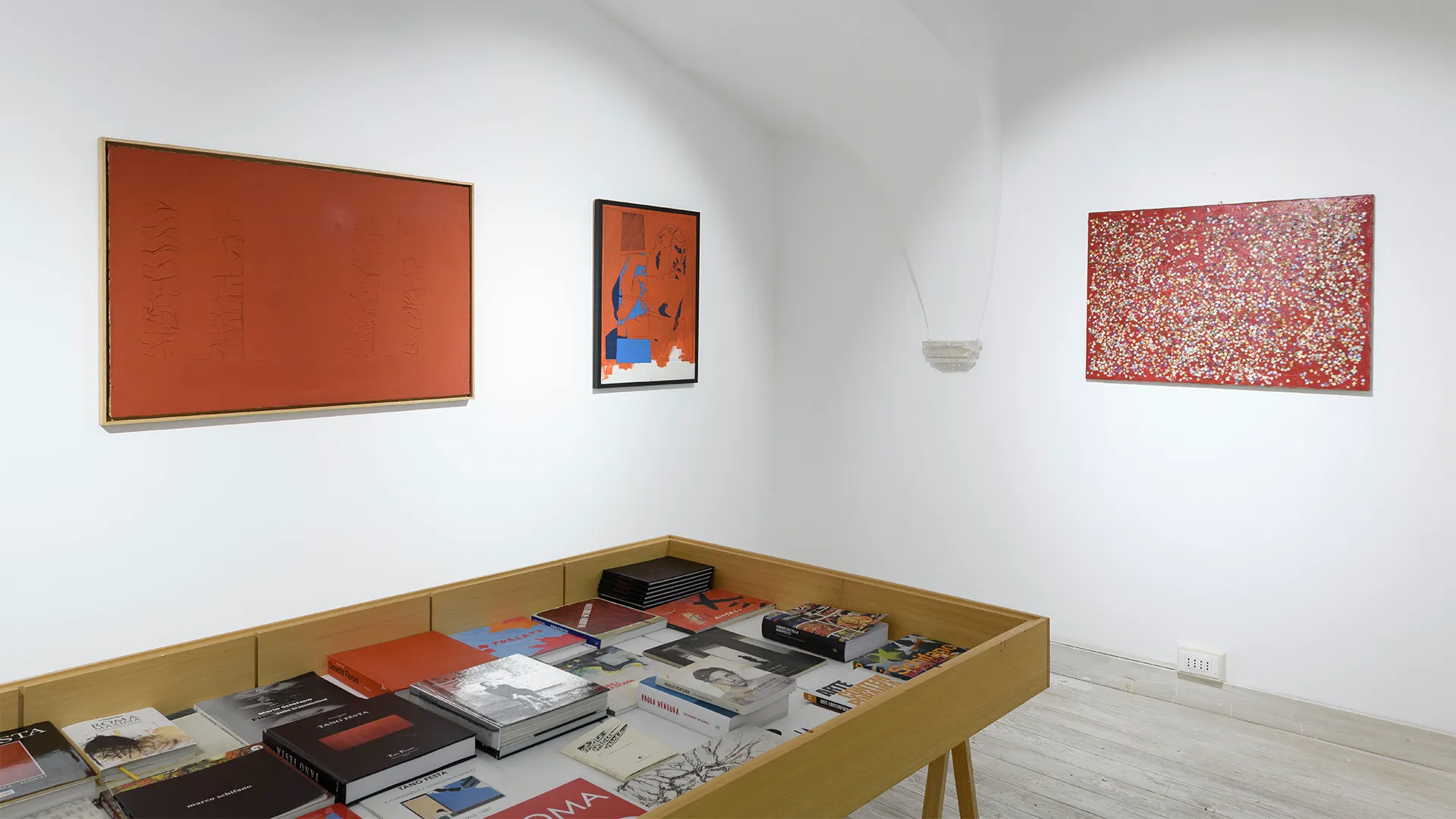
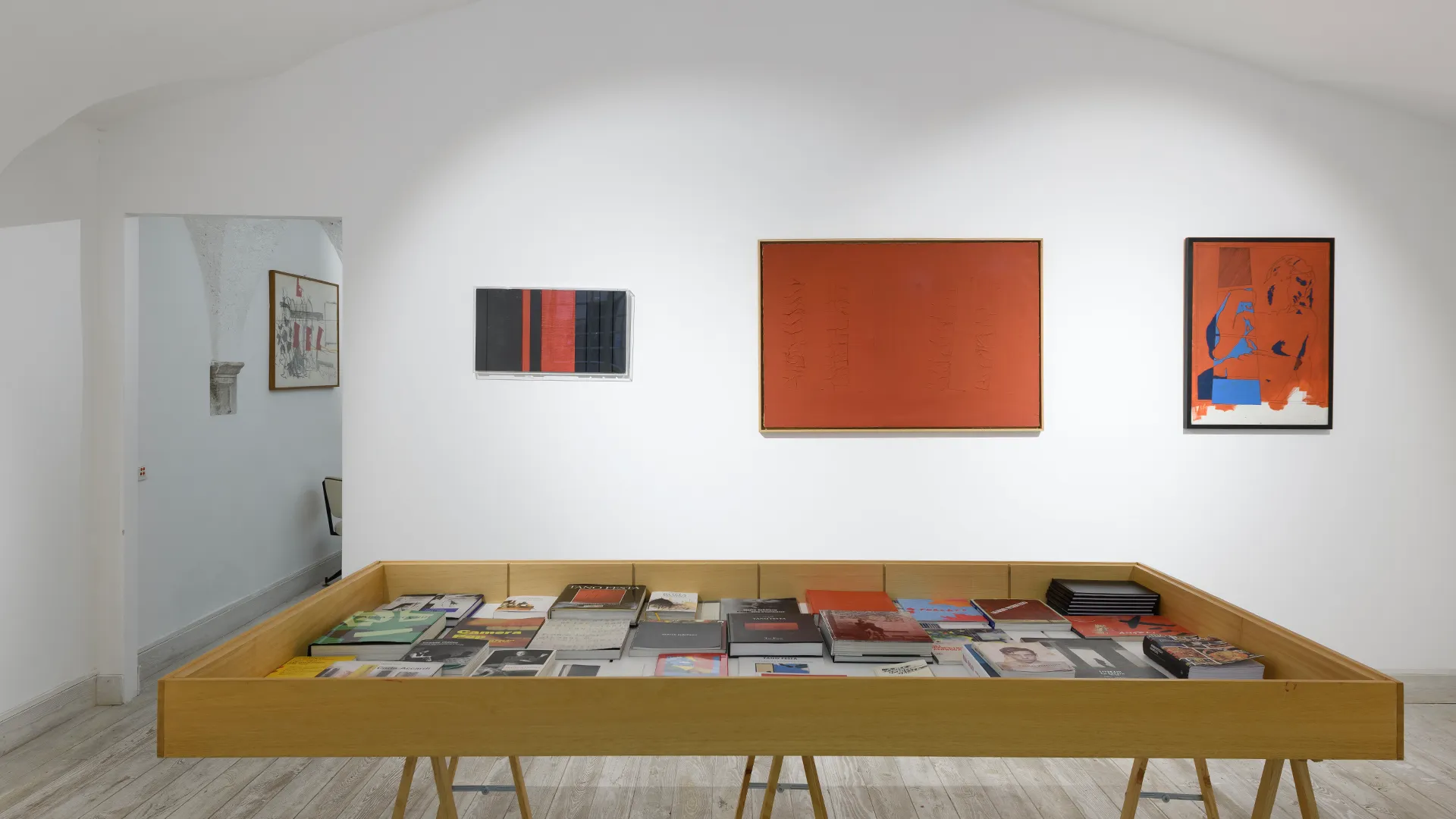
A Chinese legend tells of the impossibility of escaping one’s destiny, marked by a red thread that evokes a sentimental idea before a chromatic one. Following this red thread, the exhibition explores a series of mutual gazes and influences, collaborations—more or less declared—similarities, distances, and legacies.
First and foremost are relationships of proximity shaped by a specific historical moment: artists such as Mario Schifano, Franco Angeli, Tano Festa, and Cesare Tacchi, in the early 1960s, addressed the same issues with different outcomes. Yet their shared effort to return to a form of painting that moved beyond the historical opposition between figuration and abstraction—which had preoccupied the previous generation—marked a crucial moment for all of them. This necessity was complicated by the demanding privilege of engaging with a national artistic history of great weight. On view, alongside Tano Festa’s Monocromo rosso, Segnale n. 12 (1961), from which the exhibition takes its starting point, an emblematic collage by Tacchi, Verde – Rosso – Verde (1962), conveys the same tension through massive, vertically juxtaposed surfaces, as do Tano Festa’s celebrated reliefs from the same period. The work Via Veneto, for example, alternates red and black wooden surfaces, creating an object that appears extracted from everyday architecture.
This dialogue with the past also defines the section devoted to contemporary artists. What emerges most clearly is a tension toward an imposing artistic legacy, particularly evident in the collaborative work by Francesca Duscià and Corrado Sassi, created specifically for Filo Rosso: the theme of Salome is examined through a double filter—art history, with Titian foremost, and the exploration of contemporary materials and surfaces. A similar reworking of pictorial and cinematic experience is present in the two photographic works by Marco Schifano, shown in Rome for the first time in this exhibition. His images are powerful, dreamlike, and rich in irony, unafraid to engage with every possible meaning of beauty.
The sale of the thirty-two photographs will entirely fund several initiatives by Beyond Lampedusa, which for four years has been working to support unaccompanied foreign minors who have arrived in Italy.