
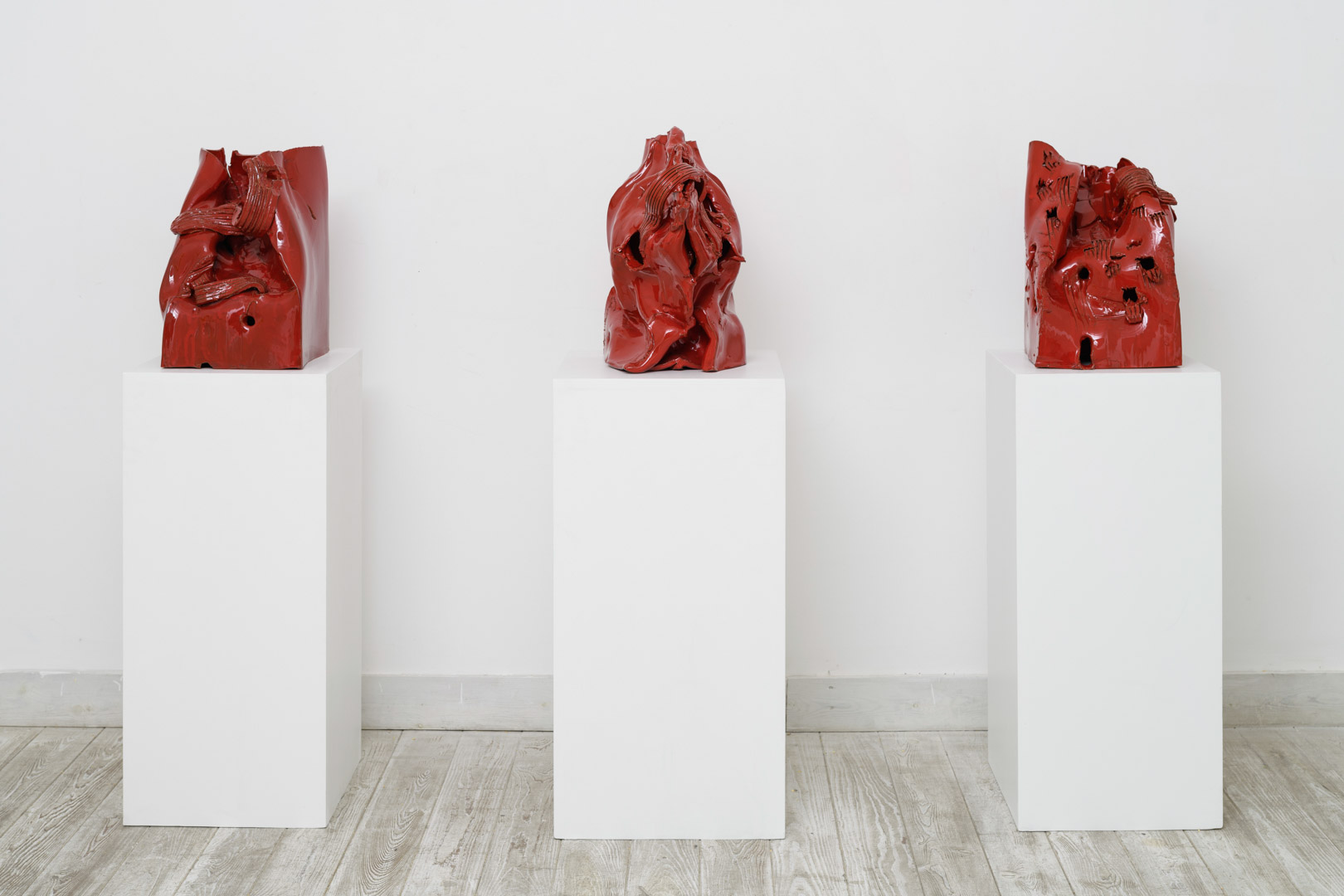
Twenty years after his death, EDDart is proud to present, from November 14, 2024 to February 28, 2025, in collaboration with the archive that represents him, a selection of works offering a retrospective look at the career of one of Italy’s greatest sculptors: Giacinto Cerone (Melfi, 1957 – Rome, 2004).
Twelve works will be displayed in the halls of Palazzo Taverna, created across different years and using a variety of materials such as ceramic, plaster, wood and moplen, highlighting the continuous experimentation of an artist whose defining trait is a strong and direct relationship with matter. Cerone, regardless of his choice of medium—and often yielding to it—expresses a dynamic tension by shaping, opening fissures, interstices and sprouts until a new form emerges.
The exhibition opens with two monumental plaster works—a material that, not by chance, marked the beginning of Cerone’s creative journey—followed at the center of the space by a sculpture that encapsulates the visionary dimension of the artist: Calle appoggiate, a swirling form in which plaster merges with moplen to create a tension within the material until a bouquet of flowers appears, one of many botanical elements in the Lucanian sculptor’s personal herbarium.
At the center of the exhibition are the historic ceramics produced in Faenza and Albissola, such as Omaggio a Gina Pane and Sansobbia, the name of a Ligurian stream that also gives the exhibition its title.
The exhibition concludes with Cerone’s wooden sculptures: Grano per una volta once again draws inspiration from the vegetal world, although here the use of wood suggests a more composed form.
In many of the works on display, the energy arises from the artist’s intention to entrust himself to the intrinsic possibilities of sculpture and of the chosen material, as well as from his belief in the fundamental absence of opposition between form and content.
Without resorting to pictorial or literary solutions, Cerone allows glimpses of his passions through his titles — Pennellata lunga, Maara, Dal monte desolato io cammino — which, often ironic and always bold, suggest rather than define, leaving viewers free to reach their own emotional and visual conclusions.
In January 2025 the MIC – Museo Internazionale delle Ceramiche in Faenza will celebrate his work with a major solo exhibition. A catalogue will accompany the exhibition, introduced by an interview between Elena Del Drago and the artist’s archive.
The exhibition is organized in collaboration with the Archivio Giacinto Cerone, Rome.