
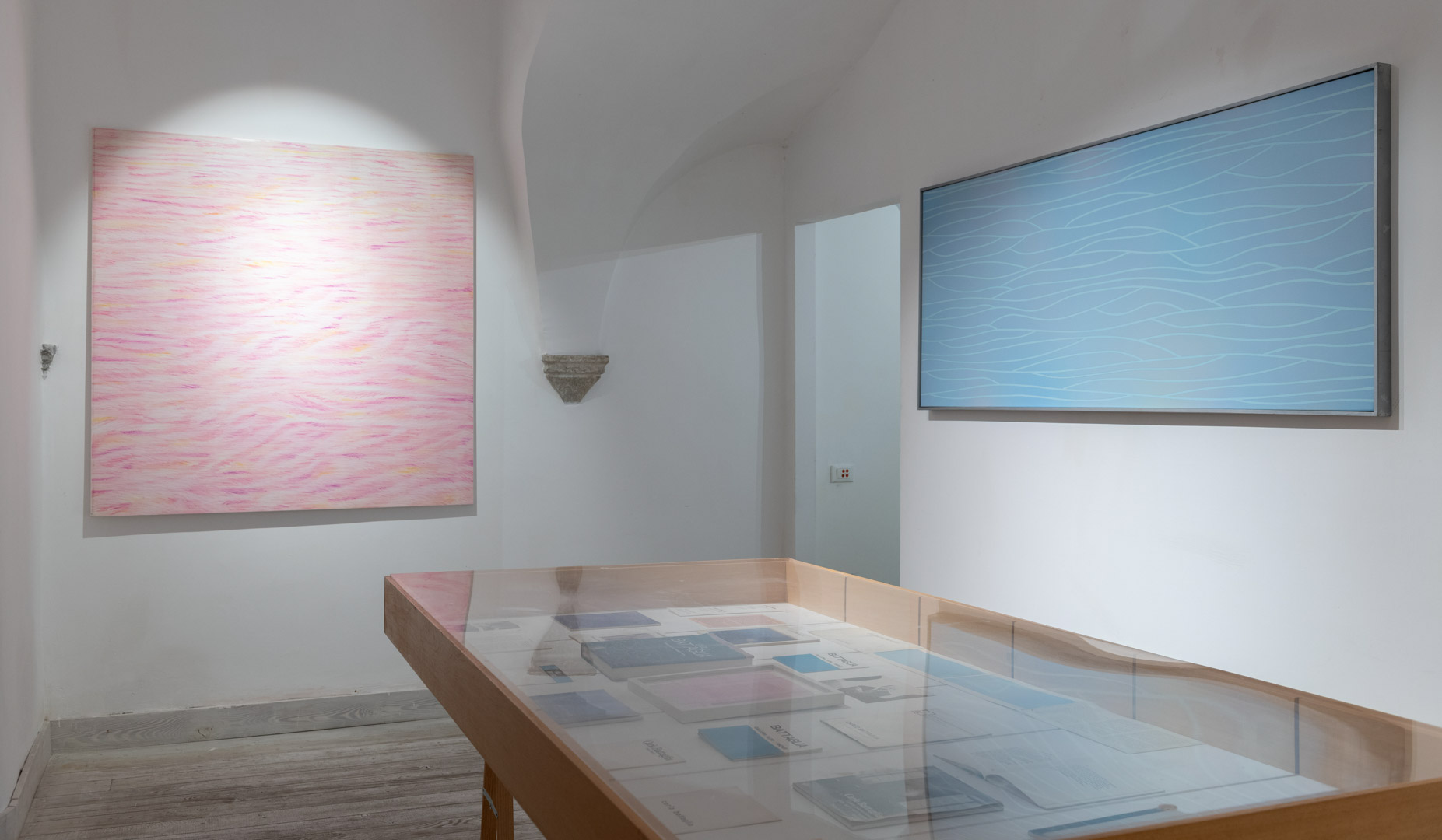
Twenty years after his death, EDDart is proud to present, from September 24 to November 29, 2025, in collaboration with the foundation that bears his name, a selection of works by Carlo Battaglia.
The works on view, spanning the years from 1972 to 1981, allow visitors to trace the development of the artist’s practice from his most strongly conceptual phase to the concentration on the theme that characterizes his entire production: the sea.
Throughout the 1970s—beginning with his participation in the Venice Biennale, where he exhibited as many as eight canvases—Battaglia was considered one of the leading figures of Analytical Painting, a movement that aimed at an increasingly detached expression of the pictorial medium. The effort was to look at painting in its essence, reducing it to a zero degree of expressiveness so that, freed from sentimentalism and excessive description, it could emerge in its pure substance.
Beyond its placement within a specific cultural and social context, the works from this “conceptual” period already reveal a feature that would remain evident throughout Battaglia’s career: the desire to focus on a single theme in order to bring forward the fundamental elements of painting—the Renaissance technique of egg tempera, the different tonalities of a single color, and the varying possibilities of light.
“Battaglia, relying on minimal means—dark colors that generate light through refraction or optical relationships, optical lines that modulate space with the subtlest shifts,” writes Marisa Volpi, “suggests the infinite possibilities that thought has to articulate vision; he does not propose a form to contemplate, but rather a particular activation of the pictorial space.”
In Battaglia’s works, the viewer’s gaze becomes absorbed in the minute repetition of the gesture, which develops primarily along a horizontal axis to evoke the endless chromatic and atmospheric transformations of the vast marine dimension. The ascetic exercise of drawing and painting succeeds in extracting a fragment of this aquatic immensity without ever placing the idea in opposition to its practical realization.