
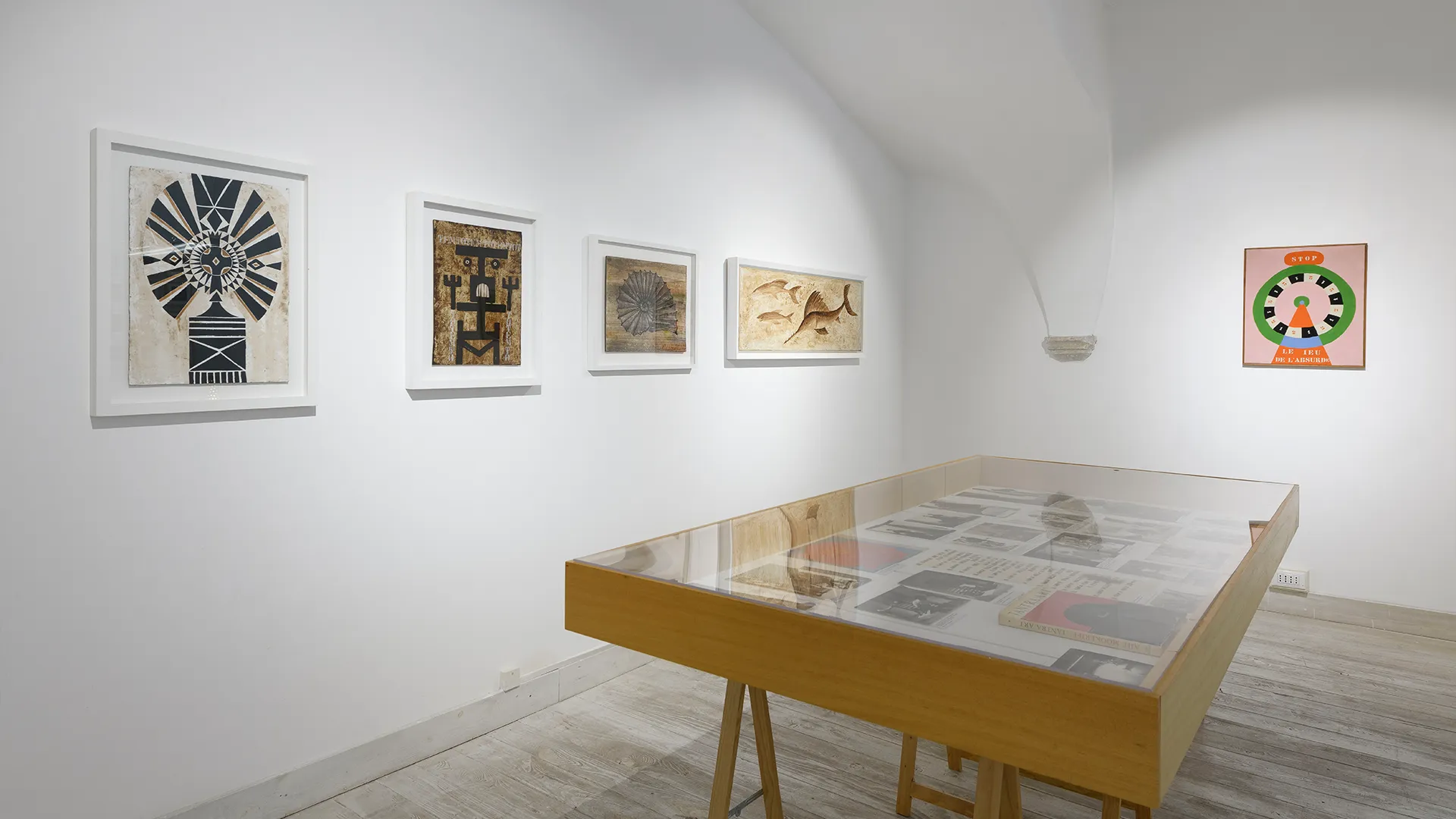
Artist, performer, and cultural animator, Anna Paparatti was a multifaceted and central figure in the formidable cultural landscape of Rome in the 1960s and 1970s. It is her gaze—as both protagonist and exceptional observer—that guides us toward a new reading of that period, restoring its experimental atmosphere, sense of freedom, international openness, and nonconformism. Curated by Alessio de’ Navasques for EDDart, the project space of Elena del Drago, the exhibition reconstructs this dense network of relationships and encounters, with a particular focus on Pino Pascali—Anna Paparatti’s close friend from their student years until his tragic death—alongside works by Toti Scialoja, Renato Mambor, and Cy Twombly.
The title Il Grande Gioco (“The Great Game”)—inspired by one of Paparatti’s early paintings from 1965—refers to the ludic dimension as a spontaneous and liberating ritual, a desacralizing yet profound research practice that reveals the essence of reality. It serves as the starting point for exploring the intertwining of art and life that characterized those years. The first Italian artist to join the Living Theatre of Julian Beck and Judith Malina, and the partner for twenty years of Fabio Sargentini—with whom she shared the extraordinary experience of Galleria L’Attico—Paparatti took part in artistic actions that would mark an era. She collaborated on the conception of festivals that brought the best of the international art and music scene to Rome, created stage designs, and designed posters.
Painting was her preferred medium, pursued through a practice in which the imagery of Tantric art is a constant presence, reinterpreted as a personal cosmogony. A selection of painted mandalas ideally opens the exhibition: the artist’s final body of work, these mystical diagrams offer a kaleidoscopic representation of the universal game. They are the outcome of an artistic and spiritual journey that begins with two works from 1965, Il Gioco del Non Senso and Le Jeu de l’Absurde, tempera on antique canvases.
A central figure in the exhibition is Pino Pascali, the shaman-artist whose disruptive creative energy perhaps better than anyone else embodied this unique moment, rich in cultural ferment. For Pascali, play is a true artistic medium—a living, open field essential to invention and transgression—not to mock, but to reveal the ludic dimension and the importance of irony. The works on view span the period from 1963 to 1967, the year before his death: these formative years appear fertile and profoundly stimulating, playing a significant role in shaping an imagination capable of arousing curiosity and interest, and of fostering a renewal of contemporary artistic languages.
A large table presents a selection of photographs and documents from Anna Paparatti’s archive, offering a visual snapshot of the period. From images with Pino Pascali and the famous toy weapons in the studio in Boccea, to photographs of artistic actions, performances, festivals, and relationships with figures such as Deborah Hay, Richard Serra, Joan Jonas, and Philip Glass, to the central role of clothing as an expressive tool and artistic medium, a constellation of relationships, friendships, affections, and tensions emerges—one that traversed the Rome of art in those years. A catalogue dedicated to the exhibition is planned, with texts by curator Alessio de’ Navasques and Maria Alicata.